
TL;DR
Thorsten Meyer has announced Corvus ISR, a planned exploitation stack for wide-area motion imagery, and released an initial synthetic browser demonstration. The artifact shows basic detection and tracking, but operational performance, real-data validation and customer demand have not been established.
Thorsten Meyer has begun publicly developing Corvus ISR, a planned software stack for exploiting wide-area motion imagery, and released a synthetic browser demonstration that detects and tracks moving objects. The announcement marks the first working artifact for a product intended to turn large volumes of persistent airborne imagery into searchable movement data while keeping processing under customer control.
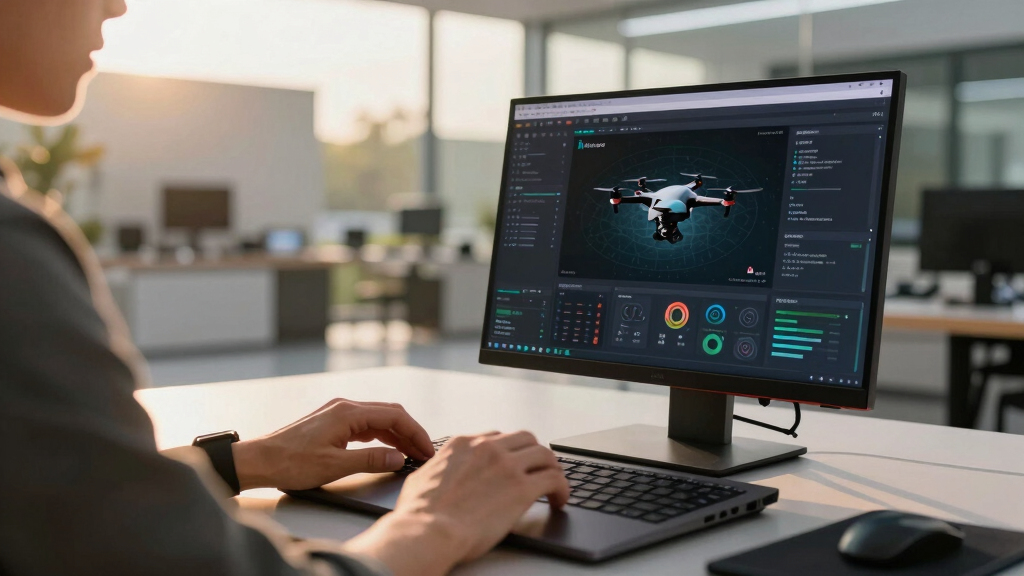
The Day 1 artifact presents a fully synthetic WAMI scene with live detection and tracking. Meyer said every pixel is generated and that the demonstration contains no imagery of real people or vehicles. Its detector uses simple geometry rather than machine learning because the first release is intended to test the development and measurement harness, not prove production-level recognition performance.
The demonstration allows traffic density to be changed so users can observe how track continuity deteriorates as the scene becomes more crowded. That failure is presented openly as part of the test. The available source does not provide measured accuracy, false-positive rates or hardware requirements, leaving the artifact as an early technical prototype rather than evidence of operational capability.
Meyer described the intended product as a stack that will detect, track and index movement, store those observations in a queryable motion database and operate on infrastructure controlled by the customer. He outlined two planned editions: a Sovereign edition for air-gapped systems without telemetry or outside dependencies, and a Governed edition for cloud operation under European Union jurisdiction. Neither edition was reported as commercially available.
Sovereign Control Shapes the Pitch
Corvus ISR is being positioned around two problems: the volume of data produced by wide-area motion imagery and European concern about dependence on foreign-controlled analysis software. WAMI sensors can continuously record movement across large areas, creating more imagery than analysts can review manually within useful operational timeframes.
If Corvus reaches its stated design goals, the software could help customers search movement histories without sending sensitive imagery to an outside service. The proposed air-gapped deployment and EU-based cloud option make data custody and jurisdiction part of the product design. Meyer’s claim that this matches current European procurement priorities remains his interpretation; the source provides no contracts, named prospective customers or independent market data.
wide-area motion imagery analysis software
As an affiliate, we earn on qualifying purchases.
As an affiliate, we earn on qualifying purchases.
Why WAMI Strains Analysis
Wide-area motion imagery uses airborne camera systems to observe a broad geographic area repeatedly over time. Meyer cited the ARGUS-IS demonstrator, known for producing 1.8-gigapixel imagery, as an example of the sensor class. At roughly one or two frames per second over hours, such systems can create a large archive that must be processed, stored and searched.
Meyer argued that collection capacity has moved ahead of exploitation tools, leaving analysts to search recorded imagery after an event. Corvus begins with synthetic data because operational WAMI imagery may be restricted, classified, expensive or legally sensitive. Generated scenes also provide known ground truth: each simulated object has a predefined identity, position and path against which detection and tracking can be measured.
Synthetic scenes can also reproduce occlusion, sensor jitter, low contrast and reduced frame rates without exposing real-world movements. Meyer acknowledged that performance on generated imagery does not establish performance on operational footage. The proposed sequence is to build and benchmark the pipeline synthetically before seeking access to real WAMI data.
“A WAMI exploitation stack that detects, tracks, and indexes everything that moves in a wide-area scene, turns it into a queryable motion database, and does it on infrastructure the customer controls.”
— Thorsten Meyer, describing the Corvus ISR product thesis
synthetic WAMI scene detection tool
As an affiliate, we earn on qualifying purchases.
As an affiliate, we earn on qualifying purchases.
Operational Validation Still Pending
It is not yet clear how Corvus ISR will perform on real sensor data or whether its architecture can process operational WAMI volumes within required time limits. No independent benchmark, source-code release, pricing, delivery schedule, funding information or customer commitment was included in the source material.
The boundaries between the planned Sovereign and Governed editions also remain undefined. Details are missing on security certification, audit controls, supported sensor formats and integration with existing intelligence systems. Legal cleanliness applies to the current synthetic demonstration; any later use of real surveillance imagery would require separate review of privacy, access and retention rules.
air-gapped data analysis workstation
As an affiliate, we earn on qualifying purchases.
As an affiliate, we earn on qualifying purchases.
Benchmarks Before Real-Data Testing
Meyer said future public dispatches will document architecture decisions, working code and development mistakes as they occur. The immediate technical work is expected to extend the synthetic pipeline, introduce harder scene conditions and measure detector and tracker performance against perfect simulated ground truth.
The larger milestone will be testing Corvus against representative real-world WAMI under lawful access conditions. Results from that stage, along with deployment specifications and evidence of buyer interest, will determine whether the project advances from a browser-based prototype toward an operational exploitation product.
EU cloud-based surveillance software
As an affiliate, we earn on qualifying purchases.
As an affiliate, we earn on qualifying purchases.
Key Questions
What is Corvus ISR?
Corvus ISR is a proposed software stack for detecting, tracking and indexing movement in wide-area motion imagery. Its stated goal is to create a searchable motion database on infrastructure controlled by the customer.
What was released on Day 1?
The first artifact is a browser-based synthetic scene with live geometric detection and tracking. It is a working prototype, but it does not use real WAMI footage or a machine-learning detector.
Does the demo contain surveillance footage of real people?
No. Meyer said every pixel is synthetic and the scene contains no real people, vehicles or imagery.
Has Corvus ISR been tested on operational WAMI?
No such test was reported. Real-data performance, processing scale and accuracy remain unverified based on the supplied source.
How would the two planned editions differ?
The planned Sovereign edition would run in air-gapped environments without telemetry or outside dependencies. The proposed Governed edition would support EU-jurisdiction cloud use with audit and compliance features, though detailed specifications have not been released.
Source: Thorsten Meyer AI