A premium video doorbell should do more than show who is at the door: it should capture useful detail, fit your power setup, and make saved footage easy to access. My best overall pick is the Google Nest Doorbell (Wired, 3rd Gen) for its 2K HDR video and wired design; the eufy E340 with HomeBase 3 stands out for dual-camera coverage and expandable local storage, while the Reolink Battery Video Doorbell (2nd Gen) suits homes that need a wireless installation. The main tradeoffs are wired reliability versus battery flexibility, a single wide view versus a second camera for packages, and cloud features versus local recording. Premium features only pay off when they match your entryway, network, and storage preferences. Read on for the full comparison and advice on choosing the right fit.

Get gifts for the two of you delivered free with Prime
- Fast, free delivery on millions of items
- Prime Video, Amazon Music and more included
- Member-only deals all year
Key Takeaways
- Google Nest Doorbell (Wired, 3rd Gen) leads for buyers who want a wired installation and 2K HDR; the Hazel and Snow versions share the same core role, so choose by finish and availability.
- eufy E340 with HomeBase 3 is the standout for shoppers who want dual-camera views plus expandable local storage, while its larger system setup makes less sense for a simple, single-camera installation.
- Reolink Battery Video Doorbell (2nd Gen) offers a strong balance of wireless flexibility and 2K capture; the two Reolink listings describe closely related versions, so compare the exact package before buying.
- Arlo Video Doorbell 2K offers a flexible wired-or-wireless setup, but buyers should weigh its feature and service ecosystem against local-storage-focused alternatives.
- Dual-camera models from eufy, Philips, and Anona address the blind spot below a conventional doorbell view; they are most useful for visible package drop-offs, not every entrance.
| Reolink Battery Video Doorbell (2nd Gen), 2K 4MP Wireless Camera |  | Best for Subscription-Free Flexibility | Resolution: 2K, 4MP | Field of view: 150° × 150° × 180° | Wi-Fi: 2.4GHz and 5GHz | VIEW ON AMAZON | See Our Full Breakdown |
| Google Nest Doorbell (Wired, 2nd Gen), Video Doorbell Camera, Ash |  | Best for Google Home Households | Model: 2nd Generation | Power: Wired | Field of view: 145° diagonal, 3:4 ratio | VIEW ON AMAZON | See Our Full Breakdown |
| REOLINK Battery Video Doorbell (2nd Gen), 2K 4MP Wireless Outdoor Camera |  | Best for Local-Storage Power Users | Resolution: 4MP (2048 × 2048) | Field of view: 150° × 150° × 180° | Battery life: Up to 10 months based on 5 minutes of recording per day | VIEW ON AMAZON | See Our Full Breakdown |
| Arlo Video Doorbell 2K (2nd Gen) Wireless or Wired – 1 Camera + Chime |  | Best Ready-to-Use Chime Bundle | Resolution: 2K | Field of view: 180 degrees | Power options: Wireless rechargeable battery or wired trickle charging | VIEW ON AMAZON | See Our Full Breakdown |
| eufy Security Video Doorbell E340 with Dual Cameras |  | Best for Package Monitoring | Camera system: Dual cameras | Video resolution: 2K | Field of view: 160 degrees | VIEW ON AMAZON | See Our Full Breakdown |
| Philips Security Video Doorbell Camera with Chime, Dual Cameras, 2K QHD |  | Best for Subscription-Free Dual-Camera Coverage | Resolution: 2K QHD | Camera setup: Dual cameras | Local storage: Up to 8 GB | VIEW ON AMAZON | See Our Full Breakdown |
| Anona 3K Dual Camera Video Doorbell with No Subscription and Chime |  | Best for High-Resolution Local Storage | Resolution: 3K, 5MP | Camera setup: Dual cameras | Battery capacity: 5,200 mAh | VIEW ON AMAZON | See Our Full Breakdown |
| ecobee Smart Video Doorbell Camera, Wired 1080p HDR |  | Best for Apple HomeKit Households | Resolution: 1080p HDR | Field of view: 175° vertical, 187° diagonal | Power: Wired; 16–24 VAC transformer, at least 10 VA | VIEW ON AMAZON | See Our Full Breakdown |
| Google Nest Doorbell (Wired, 3rd Gen), 2K HDR, Hazel |  | Best for Google Home Integration | Model: Nest Doorbell (Wired, 3rd Gen) | Color: Hazel | Video: 2K HDR | VIEW ON AMAZON | See Our Full Breakdown |
| Tapo D225 2K+ Smart Video Doorbell with Chime |  | Best Overall for Flexible Premium Coverage | Resolution: 2K QHD | Field of view: 180° head-to-toe | Power options: 8–24 V hardwired or built-in 10,000 mAh battery | VIEW ON AMAZON | See Our Full Breakdown |
| Blink Video Doorbell + Outdoor 4 Wireless Smart Security Cameras System |  | Best Premium Multi-Camera System | Included devices: Video Doorbell and Outdoor 4 camera | Video resolution: HD doorbell video; 1080p Outdoor 4 video | Battery life: Up to 2 years | VIEW ON AMAZON | See Our Full Breakdown |
| BOIFUN Video Doorbell Camera Wireless – 2K HD, No Subscription Required | 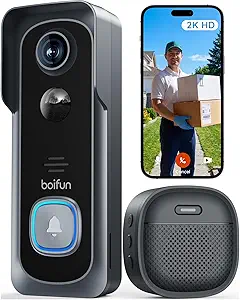 | Best Premium Pick Without a Required Subscription | Resolution: 2K HD | Field of view: 166° | Aperture: f/2.5 | VIEW ON AMAZON | See Our Full Breakdown |
| eufy Security Video Doorbell E340 with HomeBase 3 – 2K Full HD Dual Cameras, Head-to-Toe View, Wired/Battery Power, Delivery Guard, Color Night Vision, Two-Way Talk, Expandable Local Storage up to 16 TB |  | Best Premium Pick for Package Coverage | Resolution: 2K Full HD | Camera system: Dual cameras: front-facing and downward-facing | Night vision: Color, up to 16 feet (5 meters) | VIEW ON AMAZON | See Our Full Breakdown |
| Google Nest Doorbell (Wired, 3rd Gen) – 2K HDR Video, Live View, Snow |  | Best Premium Wired Choice | Video resolution: 2K HDR | Field of view: 166° | Power source: Wired | VIEW ON AMAZON | See Our Full Breakdown |
| video doorbell premium | Field of view | Resolution | Smart home compatibility |
|---|---|---|---|
| Reolink Battery Video Doorbell | 150° × 150° × 180° | 2K, 4MP | Google Assistant, IFTTT, and Home Assistant |
| Google Nest Doorbell | 145° diagonal, 3:4 ratio | — | Google Assistant and compatible Amazon Alexa devices |
| REOLINK Battery Video Doorbell | 150° × 150° × 180° | 4MP (2048 × 2048) | Google Assistant, IFTTT, and Home Assistant via Reolink Home Hub |
| Arlo Video Doorbell 2K | 180 degrees | 2K | — |
| eufy Security Video Doorbell E | 160 degrees | — | — |
| Philips Security Video Doorbel | — | 2K QHD | Amazon Alexa and Google Assistant |
| Anona 3K Dual Camera Video Doo | — | 3K, 5MP | Alexa and Google Assistant |
| ecobee Smart Video Doorbell Ca | 175° vertical, 187° diagonal | 1080p HDR | Amazon Alexa, Google Home, Apple HomeKit, and ecobee app |
| Google Nest Doorbell | 166° | — | — |
| Tapo D225 2K+ Smart Video Door | 180° head-to-toe | 2K QHD | Alexa and Google Assistant |
| Blink Video Doorbell + Outdoor | — | — | — |
| BOIFUN Video Doorbell Camera W | 166° | 2K HD | — |
| eufy Security Video Doorbell E | — | 2K Full HD | — |
| Google Nest Doorbell | 166° | — | — |
More Details on Our Top Picks
Reolink Battery Video Doorbell (2nd Gen), 2K 4MP Wireless Camera
The Reolink Battery Video Doorbell suits buyers who want a premium view without making cloud storage the center of the system. Its 2K, 4MP head-to-toe video, HDR, and night vision help show both visitors and the area around the doorstep, while local storage can go to a microSD card, Home Hub, NVR, or FTP. That range gives it a more flexible storage path than the Google Nest Doorbell (Wired, 2nd Gen), which centers access on the Google Home app and offers three hours of free event history. Reolink also supports battery or low-voltage wired power and dual-band Wi-Fi. The tradeoff is that the chime and solar charger are separate purchases, and its stated battery life assumes limited daily recording. I’d skip it if a ready-to-use chime or third-party mechanical chime support is a priority.
Pros:- 2K, 4MP head-to-toe view with HDR and night vision
- Battery, 8–24VAC wiring, and separately sold solar charging options
- Local storage support, including microSD up to 512GB, Home Hub, NVR, and FTP
- AI detection, two-way audio, voice changer, and preset replies
Cons:- Compatible Reolink Chime Plus and solar charger are sold separately
- Up to 10 months of battery life is based on five minutes of recording per day
- Not recommended for use with third-party mechanical chimes
Best for: Homeowners who want battery installation, local recording choices, and smart detection without relying on a subscription.
Not ideal for: Buyers who need an included indoor chime, plan to use a third-party mechanical chime, or expect frequent recording to match the stated battery-life estimate.
- Resolution:2K, 4MP
- Field of view:150° × 150° × 180°
- Wi-Fi:2.4GHz and 5GHz
- Battery life:Up to 10 months at 5 minutes of recording per day
- Storage:MicroSD up to 512GB; also supports Reolink Home Hub, NVR, and FTP
- Power options:Rechargeable battery, 8–24VAC wiring, or separately sold solar charger
- Smart features:HDR, night vision, motion and AI detection, two-way audio, and voice changer
- Smart home compatibility:Google Assistant, IFTTT, and Home Assistant
- Chime:Not included; compatible with Reolink Chime Plus
Our verdict“Choose this Reolink if local storage and flexible power matter more than getting an included chime or minimizing setup decisions.”
Google Nest Doorbell (Wired, 2nd Gen), Video Doorbell Camera, Ash
The Nest Doorbell makes the most sense for buyers already using Google Home who want useful event sorting without charging a battery. It can distinguish people, packages, animals, and vehicles, so alerts offer more context than a basic motion notification. Three hours of free event video history also gives it an accessible starting point, while the Reolink Battery Video Doorbell offers broader local-storage options for households that prefer to manage recordings themselves. Nest’s wired power avoids battery upkeep, but installation depends on a compatible transformer and chime, both sold separately. The Google Home app is required; this model does not work with the Nest app or website. Buyers who want extended history or familiar-face detection should also account for the subscription requirement. I’d choose it for a Google-centered home, not for flexible storage or app choice.
Pros:- Distinguishes between people, packages, animals, and vehicles
- Includes three hours of free event video history
- Wired power removes battery charging from routine upkeep
- Supports two-way audio and pre-recorded responses
Cons:- Compatible chime and transformer are required and sold separately
- Requires the Google Home app and a free Google account
- Extended video history and familiar-face detection require a subscription
Best for: Google Home users with compatible existing wiring who want categorized alerts and no battery charging.
Not ideal for: Renters, buyers without a compatible transformer and chime, or anyone who wants local storage or access through the Nest app.
- Model:2nd Generation
- Power:Wired
- Field of view:145° diagonal, 3:4 ratio
- Free video history:3 hours of event history
- App:Google Home app; requires a free Google account
- Smart home compatibility:Google Assistant and compatible Amazon Alexa devices
- Color:Ash
- Recycled materials:43% post-consumer recycled materials
Our verdict“Pick the wired Nest if Google Home integration and categorized alerts outweigh app restrictions and the need for compatible wiring.”
REOLINK Battery Video Doorbell (2nd Gen), 2K 4MP Wireless Outdoor Camera
This Reolink is a strong fit for buyers who want to choose where recordings live, from a microSD card to a Home Hub, NVR, or FTP setup. Its 4MP, 1:1 head-to-toe view combines with HDR and night vision to capture more of the entryway than a narrow visitor-only frame. Compared with the Arlo Video Doorbell 2K (2nd Gen), this model emphasizes local storage and detection without a subscription, while Arlo includes a chime and offers its own cloud-history path. Reolink also allows battery or 8–24VAC wired power and supports person, vehicle, animal, and package detection. The main compromise is ecosystem setup: full chime compatibility calls for Reolink Chime Plus, and third-party mechanical chimes are not recommended. Battery-life claims also rely on modest daily recording.
Pros:- 4MP 1:1 head-to-toe video with HDR and night vision
- Person, vehicle, animal, and package detection without a subscription
- Battery or 8–24VAC wired power
- Local recording supports microSD up to 512GB, Home Hub, NVR, or FTP
Cons:- Reolink Chime Plus is required for supported chime use
- Third-party mechanical chimes are not recommended
- The up-to-10-month battery estimate assumes five minutes of recording per day
Best for: Tech-comfortable homeowners who want a head-to-toe image, multiple local recording options, and no-subscription detection.
Not ideal for: Buyers seeking a simple included-chime setup, third-party mechanical chime compatibility, or battery life under heavy recording.
- Resolution:4MP (2048 × 2048)
- Field of view:150° × 150° × 180°
- Battery life:Up to 10 months based on 5 minutes of recording per day
- Wired power:8–24 VAC
- Wi-Fi:2.4GHz and 5GHz
- Local storage:MicroSD up to 512GB, Reolink Home Hub, NVR, or FTP
- Dimensions:7.76 × 3.86 × 2.87 inches
- Video format:MP4
- Smart home compatibility:Google Assistant, IFTTT, and Home Assistant via Reolink Home Hub
Our verdict“Choose this Reolink over cloud-centered alternatives if flexible local recording and subscription-free detection are your priorities.”
Arlo Video Doorbell 2K (2nd Gen) Wireless or Wired – 1 Camera + Chime
The Arlo package stands out for buyers who want an indoor alert included rather than sourcing a compatible chime separately. Its 2K video and 180-degree field of view pair with battery or wired trickle-charging options, giving it installation flexibility similar to the Reolink Battery Video Doorbell. Arlo also adds a built-in siren and smart detection for people, vehicles, packages, and animals, while the Reolink models offer more clearly defined local-storage choices and detection without a subscription. That distinction matters: Arlo’s full smart-detection features and extended video history require a paid subscription, and the listed cloud-history period is a trial. It also uses 2.4GHz Wi-Fi only, which may limit network flexibility. I’d favor Arlo when an included chime and deterrence features matter more than subscription-free recording.
Pros:- 2K resolution and a 180-degree field of view
- Wireless rechargeable battery or wired trickle-charging power
- Includes an indoor chime and built-in siren
- Smart detection covers people, vehicles, packages, and animals
Cons:- Full smart-detection features and extended video history require a paid subscription
- Uses 2.4GHz Wi-Fi only
- Wired setup may be complex for buyers unfamiliar with doorbell wiring
Best for: Households seeking a flexible battery-or-wired installation with an included indoor chime and a built-in siren.
Not ideal for: Buyers who want full smart detection and extended video history without a subscription, or need 5GHz Wi-Fi support.
- Resolution:2K
- Field of view:180 degrees
- Power options:Wireless rechargeable battery or wired trickle charging
- Weather resistance:IP65
- Connectivity:2.4GHz Wi-Fi
- Cloud storage:60-day video history trial included
- Included accessories:One camera and chime
- Security features:Smart detection, two-way audio, night vision, and built-in siren
Our verdict“Choose Arlo if an included chime and flexible power matter more than avoiding a subscription for advanced detection and history.”
eufy Security Video Doorbell E340 with Dual Cameras
The E340’s strongest reason to make this list is its dual-camera layout: one view covers visitors while a second points down toward deliveries. That makes package checks more direct than relying on a single wide-angle frame, including the 180-degree view on the Arlo Video Doorbell 2K. It records in 2K, offers color night vision up to 16 feet, and stores footage locally in its built-in 8GB eMMC, avoiding a required subscription for that storage. Battery or wired installation adds flexibility, though wired setup needs a 16–24V source. The key limitation is capacity: 8GB is fixed onboard storage, unlike the Reolink options’ expandable microSD and other recording paths. I’d choose E340 for doorstep coverage, not for a large local archive.
Pros:- Dual cameras show visitors and the area below for packages
- 2K video with color night vision up to 16 feet
- Built-in 8GB local storage without a required subscription
- Supports battery or wired installation
Cons:- Local storage is limited to 8GB
- Wired installation requires a 16–24V power source
Best for: Frequent online shoppers who want a separate downward view of packages and local recording without a required subscription.
Not ideal for: Households that need expandable or high-capacity local storage, or buyers without a suitable 16–24V supply who prefer wired installation.
- Camera system:Dual cameras
- Video resolution:2K
- Field of view:160 degrees
- Local storage:8GB eMMC
- Power:Battery powered or wired (16–24V)
- Night vision:Color night vision, up to 16 ft (5 m)
- Mount type:Wall mount
- Compatible assistants:Amazon Alexa and Google Assistant
Our verdict“Pick the E340 if seeing packages separately from visitors matters more than expandable storage or a larger recording archive.”
Philips Security Video Doorbell Camera with Chime, Dual Cameras, 2K QHD
I’d shortlist this Philips for households that want a second view of the doorstep without paying for a cloud plan. Its dual cameras help cover visitors and parcels near the ground, while encrypted local storage up to 8 GB keeps motion clips on the device. Compared with the Tapo D225, Philips also offers dual cameras, but the Tapo has a wider stated head-to-toe view, longer claimed battery life, and microSD expansion up to 512 GB. Philips counters with radar, PIR, and human detection, plus battery or wired power. One limitation matters: live streaming uses only the front camera, so the lower view is not a second live feed. Wired installation also needs a compatible 8–24 V source rated above 10 VA.
Pros:- Dual cameras capture visitors and packages near the doorstep.
- Stores up to 8 GB of motion video locally with AES 128-bit encryption.
- Can run on a 10,000 mAh battery or compatible wired power.
- Includes radar, PIR, and human detection, along with two-way audio.
Cons:- Live streaming is limited to the front-facing camera.
- The 8 GB storage capacity is limited compared with the Tapo D225’s microSD expansion.
- Wired setup requires an 8–24 V supply rated above 10 VA.
Best for: Households that want dual-angle doorstep monitoring and encrypted local clips without a required subscription.
Not ideal for: Buyers who want to watch both camera views live or need large, expandable local storage.
- Resolution:2K QHD
- Camera setup:Dual cameras
- Local storage:Up to 8 GB
- Encryption:AES 128-bit
- Power:Battery or wired
- Battery capacity:10,000 mAh
- Wired power requirement:8–24 V, over 10 VA
- Detection:Radar, PIR, and human detection
- Smart home compatibility:Amazon Alexa and Google Assistant
Our verdict“Choose the Philips if dual-camera coverage and encrypted local recording matter more than expandable storage or live viewing from both angles.”
Anona 3K Dual Camera Video Doorbell with No Subscription and Chime
The Anona is a strong fit if resolution and expandable local recording are higher priorities than a simple, familiar setup. Its dual 5MP cameras offer two perspectives, while a microSD card supports storage up to 512 GB; the card is not included, so local recording requires an extra component. Compared with the Philips Security Video Doorbell, Anona offers much more potential storage capacity and higher stated resolution, but Philips specifies AES 128-bit encryption and a fixed onboard storage allowance. Anona adds detection for people, pets, and packages, plus customizable alerts and a voice-changing feature. Its 2.4 GHz Wi-Fi requirement and more involved setup may be a hurdle for buyers seeking a plug-and-play experience. The 5,200 mAh battery is rated for up to 100 days, though actual runtime depends on use.
Pros:- Dual 5MP cameras provide two viewing perspectives at 3K resolution.
- Supports microSD cards up to 512 GB for local video storage.
- People, pets, and package detection can tailor alerts to doorstep activity.
- Offers battery or wired installation and includes a chime.
Cons:- A microSD card is not included, adding a separate storage purchase.
- Requires a 2.4 GHz Wi-Fi connection for full functionality.
- Setup may be more involved than with simpler wired options such as the ecobee doorbell.
Best for: Buyers who want dual-camera 3K footage, broad local storage capacity, and alerts without a required subscription.
Not ideal for: Shoppers who want included expandable storage, 5 GHz Wi-Fi support, or the simplest setup process.
- Resolution:3K, 5MP
- Camera setup:Dual cameras
- Battery capacity:5,200 mAh
- Claimed battery life:Up to 100 days
- Storage support:Up to 512 GB microSD; card not included
- Wi-Fi:2.4 GHz
- Weather resistance:IP65
- Smart home compatibility:Alexa and Google Assistant
- Chime:Included
Our verdict“Pick the Anona if you want high-resolution dual views and substantial local storage, and don’t mind supplying a microSD card or spending extra time on setup.”
ecobee Smart Video Doorbell Camera, Wired 1080p HDR
I’d place the ecobee on the list for buyers whose smart-home setup matters as much as doorbell footage. Its 175-degree vertical field of view and 187-degree diagonal view help show more of the entryway, and support for Apple HomeKit sets it apart from the Philips and Tapo models, which list Alexa and Google Assistant instead. The tradeoff is resolution: ecobee’s 1080p HDR is below the 2K Philips and Tapo D225, so buyers who prioritize detail may prefer those alternatives. It also needs existing wiring and a 16–24 VAC transformer rated at least 10 VA. Motion and person alerts are available, but package detection and 30-day video storage require a subscription. That makes this a better fit for a wired, Apple-centered home than for someone seeking subscription-free recording.
Pros:- Works with Apple HomeKit as well as Alexa, Google Home, and the ecobee app.
- Very wide stated field of view covers 175 degrees vertically and 187 degrees diagonally.
- Includes 1080p HDR video, night vision, and two-way audio.
- Supports motion and person alerts with customizable activity zones.
Cons:- Requires existing wiring and a compatible 16–24 VAC transformer rated at least 10 VA.
- 1080p resolution is lower than the 2K Philips and Tapo D225.
- Package detection and 30-day video storage require an ecobee Smart Security subscription.
Best for: Apple HomeKit households with compatible doorbell wiring that want a broad view and smart-home integration.
Not ideal for: Renters, battery-only shoppers, or buyers who want higher-resolution video and package detection without a subscription.
- Resolution:1080p HDR
- Field of view:175° vertical, 187° diagonal
- Power:Wired; 16–24 VAC transformer, at least 10 VA
- Night vision range:30 feet
- Audio:Two-way
- Smart home compatibility:Amazon Alexa, Google Home, Apple HomeKit, and ecobee app
- Operating temperature:-25 to 45°C (-13 to 113°F)
- Dimensions:2.5 x 3.5 x 7.5 inches
Our verdict“Choose the ecobee if HomeKit support and a wide view outweigh the need for battery power, 2K footage, or subscription-free package recording.”
Google Nest Doorbell (Wired, 3rd Gen), 2K HDR, Hazel
The Nest Doorbell makes the most sense for a wired entryway already built around Google Home. Its 2K HDR video, color night vision, and 166-degree field of view provide a detail-focused view, while intelligent alerts and two-way audio cover everyday doorstep use. Compared with the Tapo D225, the Nest gives up battery operation and microSD recording, but it may suit buyers who prefer Google’s app and ecosystem over flexible installation and local card storage. Google Home and Gemini features add to that appeal, though some advanced functions and enhanced notifications need a Google Home Premium subscription. The fixed wired design also rules it out for many renters and homes without compatible wiring. I’d choose it for ecosystem fit and steady wired power, not for subscription-free storage or the broadest stated view in this group.
Pros:- 2K HDR video and color night vision support detailed day and nighttime viewing.
- Wired power avoids routine battery charging or replacement.
- Works with Google Home and includes two-way audio and intelligent alerts.
- Includes mounting components such as a base plate, wedge, spacers, and chime connector.
Cons:- Requires a wired installation and is not suitable for battery-only setups.
- Some Gemini and enhanced notification features require a Google Home Premium subscription.
- The 166-degree field of view is narrower than the Tapo D225’s stated 180-degree view.
Best for: Google Home users with compatible doorbell wiring who want 2K HDR video, intelligent alerts, and color night vision.
Not ideal for: Renters, battery-powered installation seekers, or buyers who want expandable local storage without a subscription.
- Model:Nest Doorbell (Wired, 3rd Gen)
- Color:Hazel
- Video:2K HDR
- Field of view:166°
- Power:Corded electric
- Connectivity:Wired and Wi-Fi
- Dimensions:5.16 x 1.65 x 1.14 inches
- Weight:4.96 ounces
- Model number:GA09968-US
Our verdict“Choose the Nest if you already use Google Home and have doorbell wiring, but pick the Tapo D225 for battery flexibility and microSD storage.”
Tapo D225 2K+ Smart Video Doorbell with Chime
I rank the Tapo D225 first for buyers who want premium coverage without committing to one power or storage setup. It combines 2K QHD video with a 180-degree head-to-toe view, color night vision with an adjustable spotlight, and detection for people, packages, and vehicles. Its built-in 10,000 mAh battery is rated for up to eight months, while wired installation can support 24/7 recording. Compared with the Philips Security Video Doorbell, the Tapo offers a wider stated view and microSD expansion up to 512 GB, though Philips adds dual cameras and specified AES encryption. Tapo’s main limits are practical: the microSD card is sold separately, and it only works on 2.4 GHz Wi-Fi. I’d favor it for adaptable coverage and local storage, rather than for shoppers who need 5 GHz networking.
Pros:- Offers wired or battery installation, with battery life rated up to eight months.
- 180-degree head-to-toe view helps include visitors and parcels in one frame.
- Supports microSD cards up to 512 GB for local storage without a required subscription.
- Includes person, package, and vehicle detection, plus color night vision with an adjustable spotlight.
Cons:- Supports 2.4 GHz Wi-Fi only, not 5 GHz.
- A microSD card is required for local recording and is not included.
- Unlike the Philips model, it uses a single camera rather than a dual-camera setup.
Best for: Homeowners who want a wide head-to-toe view, battery or wired power, and local recording without a required subscription.
Not ideal for: Households that rely on 5 GHz-only Wi-Fi or want local storage ready to use without buying a microSD card.
- Resolution:2K QHD
- Field of view:180° head-to-toe
- Power options:8–24 V hardwired or built-in 10,000 mAh battery
- Claimed battery life:Up to 8 months
- Wi-Fi:2.4 GHz; 5 GHz not supported
- Local storage:microSD up to 512 GB; card not included
- Night vision:Full color with adjustable spotlight
- Detection:Person, package, and vehicle
- Smart home compatibility:Alexa and Google Assistant
Our verdict“Choose the Tapo D225 for the broadest mix of flexible power, head-to-toe coverage, and expandable local storage, provided your network supports 2.4 GHz.”
Blink Video Doorbell + Outdoor 4 Wireless Smart Security Cameras System
I’d choose this bundle when a front-door view alone is not enough: it pairs a video doorbell with an Outdoor 4 camera, so the setup can cover more than one approach to the home. Up to two years of battery life is the standout convenience claim, while infrared night vision, motion detection, and two-way audio support day-and-night monitoring. Compared with the BOIFUN 2K doorbell, Blink offers a broader multi-camera setup rather than a higher-resolution single-doorbell pitch. The tradeoff is that the supplied specs describe HD doorbell video and 1080p Outdoor 4 video, not 2K. Cloud storage and some advanced features require a subscription, and the product data lists batteries among the included items while also noting batteries sold separately; check the exact bundle contents before buying. I’d skip it if subscription-free recording is a priority.
Pros:- Combines a video doorbell and Outdoor 4 camera for coverage beyond the front door
- Advertised battery life of up to two years can reduce battery-change frequency
- Infrared night vision and enhanced motion detection support monitoring after dark
- Two-way audio and app control make it easier to respond remotely
Cons:- Doorbell video is HD and Outdoor 4 video is 1080p, below the 2K resolution offered by BOIFUN and eufy E340
- Cloud storage and some advanced features require a subscription
- Battery inclusion details are inconsistent in the supplied product information
Best for: Households that want a coordinated doorbell and outdoor-camera setup with app control and long intervals between battery changes
Not ideal for: Buyers who want higher-resolution 2K doorbell footage or cloud and advanced features without a subscription
- Included devices:Video Doorbell and Outdoor 4 camera
- Video resolution:HD doorbell video; 1080p Outdoor 4 video
- Battery life:Up to 2 years
- Night vision:Infrared
- Audio:Two-way audio
- Detection:Enhanced motion detection
- Storage:Cloud storage; subscription required for cloud storage and some advanced features
- Included accessories:Sync Module Core, mounting kits, wall plate, removal tool, wire extenders, and USB-C cable
Our verdict“Choose Blink if you want a battery-powered doorbell bundled with an outdoor camera, but look elsewhere for 2K detail or subscription-free cloud features.”
BOIFUN Video Doorbell Camera Wireless – 2K HD, No Subscription Required
The BOIFUN is a strong fit for buyers who want 2K video and local recording without making an ongoing subscription part of the basic setup. Its 166° field of view gives the camera room to capture more of the entrance, while human detection can help keep alerts focused on people. Compared with the Blink Video Doorbell + Outdoor 4 bundle, BOIFUN is a simpler single-doorbell choice, not a multi-camera home coverage kit. It also offers microSD storage up to 128GB, though the card is not included, so local recording requires an extra purchase. The main compromises are its 2.4 GHz-only Wi-Fi and battery life of up to 60 days under laboratory conditions, which can vary with activity. I’d favor it over a subscription-led option when self-managed local storage matters more than a broader camera system.
Pros:- 2K HD resolution provides more image detail than the Blink bundle’s HD doorbell video
- 166° field of view captures a broad area around the entrance
- Essential features do not require a subscription, with local microSD storage supported
- Human detection and an anti-theft alarm add useful alert and device-security features
Cons:- Works with 2.4 GHz Wi-Fi only
- Up to 60 days of battery life is a laboratory-condition figure and may be shorter with frequent activity
- MicroSD card is not included
Best for: Homeowners who want a wireless 2K doorbell with local microSD recording and no subscription required for essential features
Not ideal for: Buyers whose Wi-Fi network relies on 5 GHz or who want long, predictable battery intervals or included storage media
- Resolution:2K HD
- Field of view:166°
- Aperture:f/2.5
- Wi-Fi:2.4 GHz only
- Night vision:Infrared, up to 10 meters
- Battery life:Up to 60 days under laboratory conditions
- Storage:Supports microSD cards up to 128GB; card not included
- App:BoifunCam
Our verdict“Pick BOIFUN for subscription-free essential features and local 2K recording, provided your network supports 2.4 GHz and you are comfortable supplying a microSD card.”
eufy Security Video Doorbell E340 with HomeBase 3 – 2K Full HD Dual Cameras, Head-to-Toe View, Wired/Battery Power, Delivery Guard, Color Night Vision, Two-Way Talk, Expandable Local Storage up to 16 TB
The E340 earns its place through two distinct camera angles: a forward-facing view for visitors and a downward-facing view that helps show parcels near the threshold. That makes it a more package-focused design than the Google Nest Doorbell (Wired, 3rd Gen), which offers a wide single-camera view and a permanent wired connection. The E340 adds 2K video, color night vision up to 16 feet, and local storage that starts at 16GB and can expand up to 16TB, giving buyers a path to keep recordings without monthly cloud fees. Those advantages come with setup and power caveats: it requires Wi-Fi and HomeBase, and the supplied information gives no battery-life estimate. I’d choose it for delivery visibility and storage flexibility, but not for the simplest installation or a clearly stated battery schedule.
Pros:- Dual cameras show visitors and the area below the doorbell where packages are left
- 2K video and color night vision up to 16 feet support detailed viewing in low light
- Built-in 16GB storage can be expanded up to 16TB
- Wired or battery power offers more installation flexibility than the wired-only Nest 3rd Gen
Cons:- Wi-Fi and HomeBase setup add equipment and configuration steps
- The supplied product information does not specify battery life
- Wall-mount installation may not suit every entryway
Best for: Online shoppers who want a downward view of deliveries, local recording, and the option to expand storage
Not ideal for: Buyers seeking the simplest doorbell installation, a standalone setup without HomeBase, or clearly specified battery runtime
- Resolution:2K Full HD
- Camera system:Dual cameras: front-facing and downward-facing
- Night vision:Color, up to 16 feet (5 meters)
- Power options:Wired or battery
- Built-in storage:16GB
- Expandable storage:Up to 16TB
- Connectivity:Wi-Fi; HomeBase setup required
- Mount type:Wall mount
Our verdict“Choose the E340 if package visibility and expandable local storage matter more than a simpler setup or a published battery-life estimate.”
Google Nest Doorbell (Wired, 3rd Gen) – 2K HDR Video, Live View, Snow
For buyers with existing doorbell wiring, Nest’s strongest advantage is straightforward: 2K HDR live video without battery recharging. Its 166° field of view and night vision suit a fixed front entrance, while encrypted video streaming addresses privacy-conscious households. Compared with the eufy Security Video Doorbell E340, Nest trades dual-angle package coverage and expandable local storage for a permanently wired design and a simpler single-camera setup. That distinction matters most if charging would be inconvenient and wiring is already available. The drawbacks are less appealing for flexible installs: placement depends on a wired connection, and Google Home Premium is needed for advanced features. I’d choose Nest over BOIFUN when continuous wired power and the Google Home ecosystem take priority, but not when local storage without a subscription is the deciding factor.
Pros:- 2K HDR video captures detailed footage with rich color
- 166° field of view provides broad entrance coverage
- Permanent wired power avoids routine battery recharging
- Encrypted video streaming and smart notifications support privacy-aware monitoring
Cons:- Wired installation limits placement and may require existing compatible wiring
- Advanced features require Google Home Premium
- Unlike the eufy E340, it does not provide a dual-camera downward view or listed expandable local storage
Best for: Google Home households with existing doorbell wiring that want a high-resolution live view without battery upkeep
Not ideal for: Renters or homeowners without compatible wiring, and buyers who want advanced features or local recording without a subscription
- Video resolution:2K HDR
- Field of view:166°
- Power source:Wired
- Night vision:Yes
- Live view:Supported
- Notifications:Smart notifications
- Video security:Encrypted video streaming
- Advanced features:Google Home Premium required
Our verdict“Choose Nest if you have doorbell wiring and value 2K HDR live viewing without battery changes, but not if flexible placement or subscription-free advanced features matter most.”

How We Picked
I compared these 14 listings by the decisions that most affect day-to-day ownership: video detail and useful coverage, wired or battery power, package visibility, storage choices, installation demands, and how much smart-home setup each asks of the buyer. A premium label alone did not earn a higher place; I favored models whose combination of features solves a clear household need without hiding meaningful tradeoffs.
The ranking puts all-around fit and dependable ownership choices ahead of niche strengths. The wired Nest 3rd Gen ranks first for buyers prioritizing a steady power source and 2K HDR, while the eufy E340 with HomeBase 3 rises for dual views and expandable local storage. Battery models rank well for installation flexibility, but they require buyers to plan for recharging. Several entries are close variants or overlapping bundles, so I treat their shared strengths carefully rather than counting a different color or package as a distinct performance advantage.
| video doorbell premium | Smart home compatibility |
|---|---|
| Reolink Battery Video Doorbell | Google Assistant, IFTTT, and Home Assistant |
| Google Nest Doorbell | Google Assistant and compatible Amazon Alexa devices |
| REOLINK Battery Video Doorbell | Google Assistant, IFTTT, and Home Assistant via Reolink Home Hub |
| Arlo Video Doorbell 2K | — |
| eufy Security Video Doorbell E | — |
| Philips Security Video Doorbel | Amazon Alexa and Google Assistant |
| Anona 3K Dual Camera Video Doo | Alexa and Google Assistant |
| ecobee Smart Video Doorbell Ca | Amazon Alexa, Google Home, Apple HomeKit, and ecobee app |
| Google Nest Doorbell | — |
| Tapo D225 2K+ Smart Video Door | Alexa and Google Assistant |
| Blink Video Doorbell + Outdoor | — |
| BOIFUN Video Doorbell Camera W | — |
| eufy Security Video Doorbell E | — |
| Google Nest Doorbell | — |
Factors to Consider When Choosing Video Doorbell Premium
Premium doorbells differ most in how they fit a home, not in how impressive a feature list looks. I would settle the installation and recording questions before comparing resolution: those choices determine which models are practical and what ownership will involve.
Match the power source to your entrance
Check whether your existing doorbell wiring can support a wired model before you shortlist one; older wiring or a missing transformer can add work that a product listing does not make obvious. Wired units avoid routine battery charging, but they are not automatically easier if the doorbell location has no usable wiring. Battery models suit renters and awkward entryways, though cold weather, frequent motion alerts, and heavy live-view use can affect how often charging is needed. A common mistake is choosing wireless only for easier installation, then mounting the device somewhere difficult to remove and recharge. Think through the full maintenance cycle, including access to the unit and whether a chime or compatible power accessory is part of the package. Pay more for wiring convenience only when the wiring is actually usable.
Choose a view that fits what happens at your door
Resolution is only one part of useful footage: framing, distance, lighting, and the height of the mounting point all affect whether a face or delivery is identifiable. A second downward-facing camera can make parcels easier to see, but it does not replace a well-positioned main camera for visitors approaching from the side. Before buying, mark the likely mounting height and inspect what the camera could miss, including steps, a storm door, or a nearby wall. Avoid paying for dual views if packages are rarely left outside or the entry is already visible from another camera. Conversely, a single-camera model may leave a persistent blind spot at a low doorstep. Choose coverage for your real traffic pattern rather than treating more lenses as automatically better.
Decide how you want to keep recordings
Live alerts and saved clips are separate needs: a doorbell can notify you promptly while limiting how much footage remains available later. Cloud services can make remote access and event history straightforward, but may require ongoing fees or an account plan for particular features. Local recording avoids some recurring-service dependence, yet it can involve a hub, storage setup, device compatibility checks, and responsibility for protecting recordings if equipment is damaged. Read the precise feature terms before purchase, since “no subscription required” does not necessarily mean every advanced function is included without one. Also ask who in the household needs access and whether clips should remain available during an internet outage. Pay for a storage approach you will actually maintain, not just the largest capacity listed.
Check chime, Wi-Fi, and smart-home compatibility
A doorbell that captures excellent video can still frustrate if its chime does not work with your existing setup or its app does not fit how your household manages alerts. Confirm whether the package includes a chime, uses an existing mechanical chime, or expects a phone notification to serve as the primary alert. Check the required Wi-Fi band and signal strength at the front door; a router that works well indoors may not reach an exterior wall reliably. Smart-home compatibility matters most when you already use a specific speaker, display, or automation platform, since mixing ecosystems can mean fewer useful controls. Avoid assuming that devices from the same broad smart-home category work together in every feature. A quick compatibility check can matter more than moving up a resolution tier.
Think about upkeep, privacy, and household access
Premium ownership includes more than the camera: app permissions, shared household access, storage security, and upkeep all shape whether the doorbell remains useful. Battery owners should plan a charging routine, while wired owners should keep a record of the transformer and chime setup for later troubleshooting. Review the privacy controls for activity zones, notification schedules, and audio before placing a camera where it may capture a sidewalk or neighboring property. If several people need alerts, check whether they can use separate accounts rather than sharing one login. A feature-rich system may call for a hub or additional setup, so consider who will manage it after installation. The best fit is the one your household can maintain without constant adjustments.
Pay for a premium feature only when it solves a real problem
Higher-end models may add HDR, sharper video, dual cameras, expandable storage, or flexible power, but each feature targets a different limitation. HDR can help with a bright doorway behind a shaded visitor, while extra resolution is less useful if your Wi-Fi cannot reliably deliver live video. A second view is most valuable for low package drop-offs; local storage matters most if you want to avoid depending on a cloud plan. Buyers often overvalue a long feature list and undervalue installation fit, app usability, or ongoing maintenance. Decide which one recurring annoyance you want to fix, then compare models on that point and the tradeoffs it brings. This approach can keep a premium purchase focused rather than paying for capabilities that stay unused.
Frequently Asked Questions
Is a wired premium video doorbell a better choice than a battery model?
Wired is usually the better fit if working doorbell wiring is already available and you want to avoid routine charging. Battery power makes more sense when wiring is absent, inaccessible, or unsuitable for your entryway. The tradeoff is ongoing upkeep: battery use depends on activity and conditions, so a busy entrance may call for more frequent charging. Check whether a wired installation needs a compatible transformer or chime before ordering. Choose based on the installation you can support, not on a general assumption that one power type is always superior.
Do I need a second camera to see packages at my doorstep?
A downward-facing second camera can help when the main lens misses parcels placed directly below the doorbell. It is not necessary for every entrance: a raised step, a clear main-camera angle, or a separate outdoor camera may already cover the drop-off area. Think about where couriers actually leave packages and whether the doorbell can be mounted at a practical height. Dual-camera options such as the eufy E340, Philips model, and Anona model are most compelling when package visibility is a recurring concern. More lenses do not guarantee a useful view if the mounting position is obstructed.
Can I avoid a monthly subscription and still save doorbell video?
Some models support local recording or offer core recording functions without a paid cloud plan, but included features vary. Check whether local storage is built into the doorbell, requires a separate hub, or depends on an additional storage device. Confirm which capabilities remain available without a subscription, including clip history, person detection, and remote playback. Local storage can reduce ongoing service dependence, but it brings setup and device-security responsibilities of its own. Compare the exact bundle and service terms rather than relying on a short “no subscription” claim.
Is 2K video worth prioritizing over a wider or dual-camera view?
It depends on what you need to identify. Higher resolution can preserve more detail in a suitable view, but it cannot show an area outside the camera frame or recover a face obscured by poor lighting. If parcels vanish from a low doorstep, a second downward view may solve more than a resolution increase. If your entrance is well framed and you want clearer visitor detail, 2K or 2K HDR may be the more relevant upgrade. Also check that your Wi-Fi and recording setup can handle the video quality you select.
How should I choose between the similar Nest and Reolink listings?
Start by comparing the exact generation, power type, finish, and included accessories shown in each listing; similar product names do not always mean identical packages. The two Nest 3rd Gen entries are listed in different finishes, Hazel and Snow, and share the wired 2K HDR role in this roundup. The Reolink Battery Video Doorbell entries are closely related 2nd Gen listings, so check whether their camera description, bundle, or included components differ. Do not treat a duplicate color or a lightly changed listing title as a meaningful performance upgrade. When specifications appear identical, choose the package that matches your installation and preferred finish.
Conclusion
For most wired households, I recommend the Google Nest Doorbell (Wired, 3rd Gen) as the best overall match for 2K HDR and a steady power source. The Reolink Battery Video Doorbell (2nd Gen) is my best value-oriented fit for shoppers who want wireless installation and 2K capture without choosing a more elaborate system; compare the two near-duplicate listings closely. For a best premium pick focused on dual-camera coverage and expandable local storage, choose the eufy E340 with HomeBase 3. Beginners with working wiring and a preference for a straightforward single-doorbell setup should start with the wired Nest, while renters or homes without suitable wiring should favor a battery model. If package visibility is the priority, look to the eufy, Philips, or Anona dual-camera options; if you want a flexible wired-or-wireless configuration, compare Arlo. The right choice is the one whose power, storage, and view match your entrance—not simply the one with the longest feature list.
Fall Picks
fall essentials
As an affiliate, we earn on qualifying purchases.