TL;DR

Get gifts for the two of you delivered free with Prime
- Fast, free delivery on millions of items
- Prime Video, Amazon Music and more included
- Member-only deals all year
Building your own AI workstation used to be cheaper, but recent component shortages and price spikes tip the scales toward buying prebuilt systems that are faster to deploy and come with validated thermals and support. Your choice depends on your need for customization, speed, and ongoing maintenance.
Imagine this: you’re ready to run your first local LLM or deep learning project. Do you pull out the screwdriver and start building, or do you click ‘Order’ on a preconfigured machine? That choice has never been more consequential. The old rule—build cheaper, buy faster—no longer holds in 2026. Now, the landscape is shaped by supply chain chaos, soaring component prices, and the need for reliable, validated performance. This article cuts through the hype, comparing what each option really offers, so you can make the smartest move based on your workload, budget, and build vs buy decision.
Whether you’re a researcher, developer, or small team, understanding the tradeoffs between building and buying your AI workstation today is critical. It’s not just about cost—think speed to deployment, operational complexity, and long-term control. Ready to find out which path aligns with your goals? Let’s break down the real story behind build vs buy in 2026.
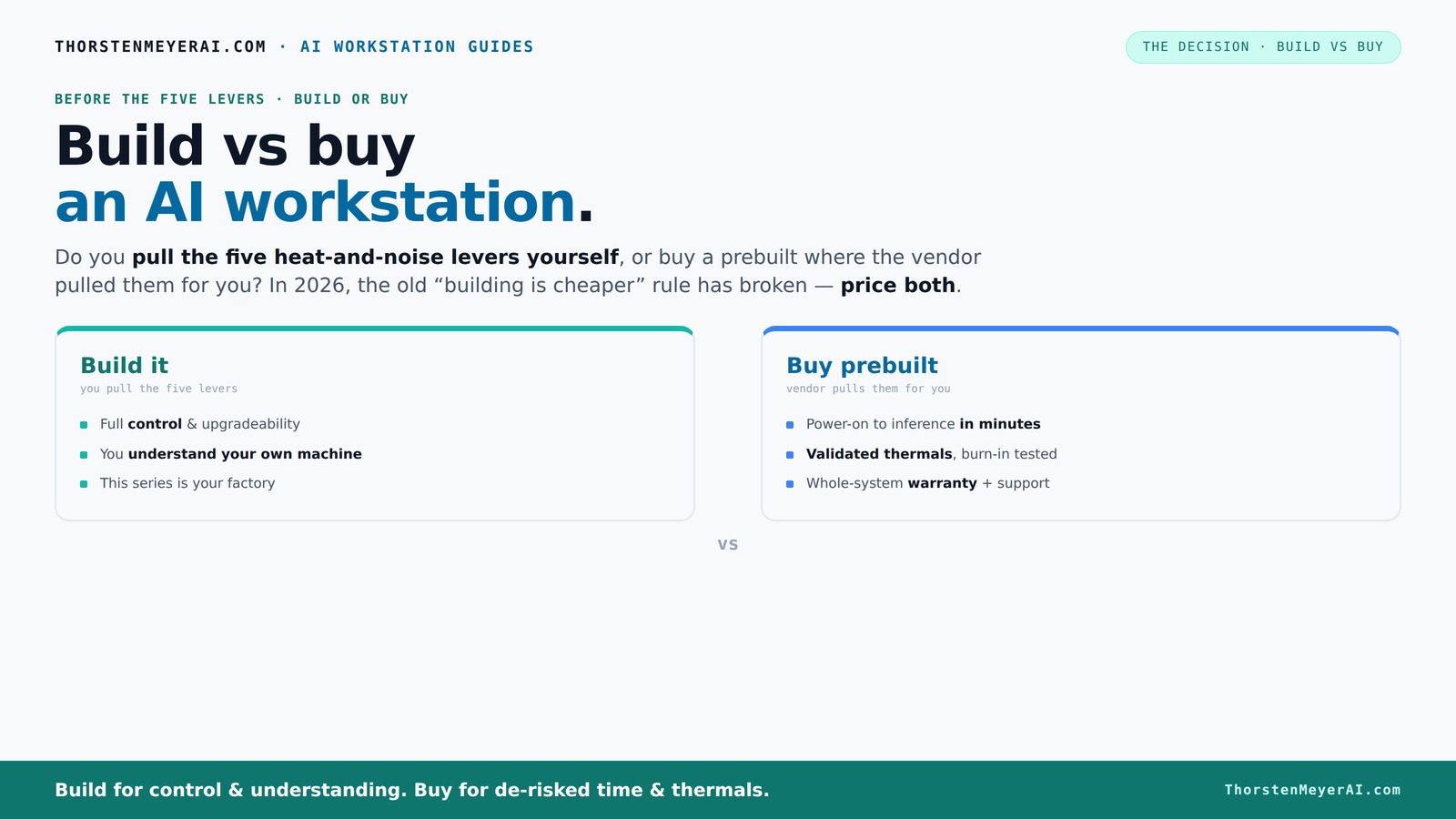
Build vs buy
an AI workstation.
The real question behind this whole series: do you pull the five heat-and-noise levers yourself, or buy a prebuilt where the vendor pulled them for you? And in 2026, the old “building is cheaper” rule has broken. Match your situation in Part 3.
Key Takeaways
- Component shortages and price spikes in 2026 often make prebuilt AI workstations more cost-effective than DIY builds.
- Speed to deployment is a major advantage of buying—systems arrive ready, tested, and support-backed, reducing setup time from weeks to days.
- Thermal validation and warranty support favor prebuilt options for high-performance, multi-GPU workloads.
- Building offers full control and customization but requires technical skill, ongoing maintenance, and troubleshooting effort.
- Hybrid strategies—buying validated systems and upgrading parts—combine speed with tailored performance.
As an affiliate, we earn on qualifying purchases.
What 'Build' and 'Buy' Actually Mean in 2026
‘Build’ means sourcing every component—GPU, CPU, RAM, cooling, case—and assembling them yourself or with a small team. You’re the chief engineer, tuning everything to your needs. ‘Buy’ is choosing a preconfigured, validated system from a vendor like Lambda or Puget, which arrives ready-to-run with thermal testing, firmware tuned, and support backed by warranty.
For example, building a high-end AI workstation might involve selecting a 4090 or A100 GPU, custom cooling, and a specific motherboard. Buying, on the other hand, could mean ordering a prebuilt system designed for AI workloads, tested for thermal efficiency, and with a support plan. The core difference? Control versus convenience.
As an affiliate, we earn on qualifying purchases.
Decision Factors: When to Build or Buy Your AI Workstation
Choosing between build and buy hinges on several key factors:
- Budget: Building used to be cheaper, but in 2026, component shortages and price spikes mean prebuilt systems can sometimes cost less overall.
- Time to value: Buying gets you up and running in days, building takes weeks or months.
- Workload complexity: Multi-GPU setups and thermal tuning favor vendor validation; simpler workloads might be fine with a DIY build.
- Support and maintenance: Buying includes warranty and vendor support; building shifts the burden to your team.
- Customization needs: If you need a specific GPU or thermal setup, building offers full control.
For instance, a data scientist needing quick access for inference might lean toward buy, while a researcher customizing hardware for a proprietary workflow might prefer to build.
As an affiliate, we earn on qualifying purchases.
Cost Comparison: Why 2026 Changes the Game
In 2026, building your own AI workstation is no longer the clear-cut cheaper route. The reason? component shortages and price hikes hit DIY parts hard. DDR5 RAM, high-end GPUs, and SSDs now command a premium. A build that used to cost around $1,200 might now climb to $1,500 or more, depending on parts.
Meanwhile, prebuilt vendors bought components in bulk before prices soared. As a result, a system that costs them $2,500 can sometimes be sold for less than piecing one together—sometimes even under $2,000, with validation and warranty included. Here’s a quick comparison:
| Build | Prebuilt |
|---|---|
| DIY parts + assembly (~$1,250+) | Vendor-validated system (~$1,800–$2,200) |
| Potential hidden costs: troubleshooting, time, miscellaneous accessories | Support, warranty, and testing included |
So, don’t assume build always wins on price anymore. Always price both options for your specific config.
As an affiliate, we earn on qualifying purchases.
Performance: Who Wins the GPU Race?
Performance depends on the GPU’s specs, cooling, and thermal management. Prebuilt systems often come with professionally tuned cooling, ensuring GPUs like the A100 or RTX 4090 run at peak without throttling. DIY builds rely on your choice of cooler and airflow, which can vary.
For example, a prebuilt might include a custom water-cooling loop that keeps the GPU 10°C cooler under load. DIYers can achieve similar results but need to spend time tuning fans and undervolting. According to recent tests, a well-tuned prebuilt system sustains higher GPU clocks longer, translating to faster training or inference.
In the end, the performance gap narrows if you’re willing to invest time in thermal tuning. But for most, vendor validation and support tip the scales.
Risks and Reliability: What Could Go Wrong?
Building your own AI workstation means you’re responsible for compatibility, stability, and thermal management. A misstep in BIOS settings or cooling can cause throttling, crashes, or hardware failure. Troubleshooting takes time and expertise.
Buying a prebuilt shifts that risk to the vendor. They’ve tested the system under load, ensuring it won’t throttle or overheat. Plus, you get warranty support if something breaks during your critical training runs.
For example, Lambda’s workstations undergo 48 hours of stress testing before shipping, reducing the chance of downtime. DIY builders usually need to run their own tests and may face unexpected issues after deployment.
Who Should Build, Who Should Buy, and When to Hybrid
Build if you’re a hobbyist, researcher, or small team with time, technical skill, and specific customization needs. You want full control over every component and are prepared for ongoing maintenance.
Buy if your priority is quick deployment, validated thermals, warranty, and minimal operational hassle. It’s perfect for fast-paced projects or teams lacking deep hardware expertise.
Hybrid strategies are increasingly popular. Buy a validated system and swap out or upgrade specific parts—like adding a custom cooling loop or specialized GPU. This approach combines speed with customization, fitting many modern workflows.
For example, start with a prebuilt and then add your own NVMe drives or upgrade RAM later. It’s a flexible middle ground.
The Final Word: Your Best Move in 2026
In the end, the choice hinges on your workload, budget, and patience. If speed and support matter most, a prebuilt system offers a reliable, validated platform ready to go. If you crave control, customization, and learning, building may still make sense—though at a higher time cost.
Remember, the landscape shifts fast. What was true in 2024 no longer applies in 2026. So, always price both options today, and consider hybrid approaches for the best of both worlds. Your perfect AI workstation is waiting—just pick the right path.
Frequently Asked Questions
Is it cheaper to build or buy a prebuilt AI workstation?
In 2026, component shortages and price spikes have made prebuilt workstations often cheaper or comparable in price to DIY builds. Always price both options for your specific configuration before deciding.How long does it take to build versus buy?
Buying typically takes days to a week for delivery, while building can take several weeks to months, depending on your experience and component availability.When should I consider a hybrid approach?
If you want quick deployment but need some customization, buy a validated system and upgrade certain parts later. It offers a balance of speed and control.What are the biggest risks of building my own AI workstation?
Risks include compatibility issues, thermal mismanagement, and longer troubleshooting times. You also take on the full responsibility for maintenance and warranty.Can a prebuilt workstation be upgraded later?
Yes, most prebuilt systems support upgrades like additional RAM, SSDs, or even GPUs, but some components may be more difficult or void warranty if altered—check with the vendor first.Conclusion
Choosing between build and buy in 2026 isn’t just about saving a few dollars—it's about what matters most: speed, support, control, or customization. The smarter move depends on your workload, skill, and patience. Whichever path you choose, stay flexible—hybrid options might just give you the best of both worlds.
Remember, in the fast-evolving AI landscape, your workstation is your foundation. Build it smart, build it right, and let your projects flourish.
Halloween Picks
halloween
As an affiliate, we earn on qualifying purchases.