For most households, I would start with the Anker SOLIX C1000 Gen 2 as the best overall portable power station for emergencies because it sits between compact, short-runtime units and the heavier high-capacity models. The Anker SOLIX S2000 is a stronger fit when longer backup runtime matters most, while the Jackery Explorer 1000 v2 offers a more manageable middle ground for essential devices. The central tradeoff is straightforward: more battery capacity can support more devices for longer, but it usually means greater size and weight. Smaller stations are easier to store and carry, though they cannot stand in for a large backup supply. Read on for the full breakdown, selection criteria, and advice on matching capacity to the emergencies you want to prepare for.

Get gifts for the two of you delivered free with Prime
- Fast, free delivery on millions of items
- Prime Video, Amazon Music and more included
- Member-only deals all year
Complete the kit


Key Takeaways
- The lineup spans very different backup roles: the 88Wh MARBERO is for small electronics, while the 2010Wh Anker SOLIX S2000 is aimed at longer-running, higher-demand backup.
- The 1,000Wh class is the middle ground: the Jackery Explorer 1000 v2, Anker SOLIX C1000 Gen 2, and 1024Wh LiFePO4 model offer more headroom than compact stations without reaching the S2000’s capacity.
- Watt-hours and output watts answer different questions: capacity affects runtime, while output limits which devices can run; a large battery can still be a poor match for an appliance whose startup or running demand exceeds its output.
- Solar-panel bundles are not interchangeable with faster recharging: the included 40W or 60W panels can support off-grid charging, but limited panel wattage may mean slow replenishment after substantial use.
- Battery chemistry and portability create a real tradeoff: several compact options use LiFePO4 batteries, while the smallest size and lowest carrying burden may matter more to buyers who only need phone and light backup.


| portable power station for emergencie | Weight | Dimensions | Capacity | Battery type |
|---|---|---|---|---|
| Portable Solar Generator 300W | — | — | — | — |
| Anker SOLIX S2000 Portable Pow | 35.7 lbs | 8.2 x 11.1 x 12.7 inches | — | LiFePO4 |
| Portable Power Station 500W | 18 lbs | 11.57 x 7.95 x 7.95 inches | — | Lithium |
| BLUETTI Elite 30 V2 Portable P | 9.4 lbs | 9.8 x 7 x 6.6 inches | 288Wh | — |
| Jackery Explorer 1000 v2 Porta | 23.8 lbs | 12.87 x 8.82 x 9.72 inches | — | LFP |
| EnginStar Portable Power Stati | 6.5 lb | 9.1 x 5 x 7 in | 296Wh | Lithium-ion |
| Anker SOLIX C300 Portable Powe | 4.13 kg | 6.46 x 6.34 x 9.45 in | 288Wh | — |
| Jackery Solar Generator 300 wi | 12.9 lb | 15.43 x 9.92 x 11.89 in | 292Wh | — |
| Jackery Explorer 300 Portable | 7.5 lb | 9.1 x 5.2 x 7.8 in | 292Wh | — |
| HOWEASY Portable Power Station | 2.3 lb | 6.6 x 3 x 4 in | 88Wh | — |
| ALLWEI Portable Power Station | 6.4 lbs | — | 256Wh | LiFePO4 |
| Anker SOLIX C1000 Gen 2 Portab | 11.3 kg | — | — | LiFePO4 |
| MARBERO Portable Power Station | 1.04 kg | 6.5 x 4.6 x 3.1 inches | 88Wh | — |
| DaranEner Portable Power Stati | 5.73 lbs | — | 192Wh | LiFePO4 |
| 1000W Portable Power Station 1 | 27.73 lbs | 18 x 12 x 16 inches | 1,024Wh | LiFePO4 |
More Details on Our Top Picks
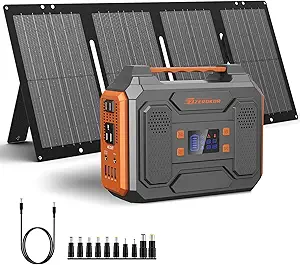
Portable Solar Generator 300W with 60W Solar Panel
I’d pick this for a small emergency kit when having a way to recharge matters more than running large equipment. Its included 60W foldable panel gives it an advantage over the Jackery Explorer 1000 v2, which requires a separately purchased compatible panel, though the Jackery offers far more stored energy and output. Here, the 300W limit suits phones, lights, and other modest loads, not high-demand appliances. Multiple USB and AC outlets let me connect several small devices, while the built-in SOS flashlight adds a practical backup feature during a power cut. Solar output depends on sunlight, and the panel’s junction box needs dry storage. I’d choose this when an all-in-one, compact setup is more useful than extended runtime.
Pros:- Includes a 60W foldable monocrystalline solar panel for recharging without a separate panel purchase.
- Multiple AC, DC, and USB outputs support several small devices at once.
- Built-in SOS flashlight can provide a useful light source during an outage.
- Protection features cover over-current, overload, overheating, and other listed risks.
Cons:- 300W output rules out appliances with higher rated power.
- The solar panel junction box is not waterproof and needs dry storage.
- The battery may lose useful charge if left uncharged for long periods.
Best for: Buyers building a compact emergency kit for phones, lights, and other low-wattage devices who want a solar panel included.
Not ideal for: Households that need to run a refrigerator or other high-wattage appliance, or anyone who cannot keep the panel junction box dry.
- Power output:300W
- Solar panel:60W monocrystalline, foldable
- AC outlets:2
- USB ports:3 USB ports and 1 Quick Charge USB port
- DC output:1 DC port
- Charging options:AC, solar, and car
- Conversion efficiency:20.5%
- Protection:Short circuit, over-current, over-voltage, overload, and overheating
Our verdict“Choose this for a small emergency setup with included solar recharging, but step up to a higher-capacity station for appliance backup.”
Anker SOLIX S2000 Portable Power Station, 2010Wh, 1500W
Among these five, I’d place the Anker SOLIX S2000 first for emergency runtime: its 2010Wh LiFePO4 battery stores nearly twice the energy of the Jackery Explorer 1000 v2 and is rated for up to 35 hours of refrigerator use. That makes it the stronger fit for keeping essential household devices going through a longer outage, rather than simply topping up phones. Its 1500W continuous output still sets a firm ceiling, so it is not a substitute for a whole-home generator or a solution for every appliance. At 35.7 pounds, it is also heavier than the Jackery and much less convenient to carry far from a vehicle. I’d choose the extra capacity over lighter portability when staying powered at home is the priority.
Pros:- 2010Wh LiFePO4 battery offers the largest stated capacity in this five-product group.
- 1500W continuous and 3000W peak output can handle more than small-device charging.
- Supports recharging by solar, AC, and car outlets.
- Listed refrigerator runtime of up to 35 hours helps frame its emergency-use potential.
Cons:- At 35.7 pounds, it is less convenient to carry than the Jackery Explorer 1000 v2 or BLUETTI Elite 30 V2.
- No 12V DC port is listed.
- 1500W continuous output excludes appliances with higher running demands.
Best for: Households seeking a high-capacity battery backup for essential devices and refrigerator use during longer outages.
Not ideal for: Buyers who need a light grab-and-go station, a 12V DC port, or backup for appliances that exceed its continuous output.
- Battery capacity:2010Wh
- Battery type:LiFePO4
- Continuous output:1500W
- Peak output:3000W
- Weight:35.7 lbs
- Dimensions:8.2 x 11.1 x 12.7 inches
- Charging options:Solar, AC, and car outlets
- Listed refrigerator runtime:Up to 35 hours
Our verdict“Pick the S2000 when longer home-outage runtime matters more than carry weight or a 12V DC connection.”
Portable Power Station 500W, 519Wh Solar Generator Backup
I see this 519Wh model as a useful middle ground for outage kits: it offers more stored energy than the BLUETTI Elite 30 V2’s 288Wh, without the Jackery Explorer 1000 v2’s greater size and 1070Wh capacity. Its USB-C PD, Quick Charge USB-A, DC, car, and wireless charging outputs give a household several ways to power small electronics, while the 500W rating leaves room for modest AC devices. That capacity is not enough for extended use of demanding appliances, and the listed solar charging time can reach nine hours in full sun. At 18 pounds, it is also less convenient to move than the BLUETTI. I’d favor it when a variety of device connections matters more than the lightest carry or the longest outage runtime.
Pros:- 519Wh capacity exceeds the BLUETTI Elite 30 V2’s 288Wh for a larger reserve.
- USB-C PD, Quick Charge USB-A, wireless charging, AC, and DC outputs cover varied devices.
- Can recharge from a wall outlet, car charger, or solar panel.
- Built-in BMS and pure sine wave inverter are listed safety and power-quality features.
Cons:- 500W output limits use with higher-wattage appliances.
- At 18 pounds, it is heavier than the BLUETTI Elite 30 V2.
- Solar charging can take up to nine hours in full sun.
Best for: People assembling an outage kit for phones, laptops, lights, and other devices with varied charging connections.
Not ideal for: Buyers who need long appliance runtime, a lightweight station for frequent carrying, or solar charging that finishes quickly.
- Battery capacity:519Wh
- Battery type:Lithium
- Output ports:2 AC, 3 USB-A QC3.0, 1 USB-C PD, 2 DC, 1 car, and wireless charger
- Charging options:Solar panel, car charger, and wall outlet
- Weight:18 lbs
- Dimensions:11.57 x 7.95 x 7.95 inches
- Solar charging time:Up to 9 hours in full sun
Our verdict“Choose this when your emergency kit needs flexible charging for several small devices, not prolonged power for large appliances.”
BLUETTI Elite 30 V2 Portable Power Station 288Wh 600W LFP Solar Generator
The BLUETTI Elite 30 V2 is the easiest model here to justify when compact size and fast transfer to backup power matter more than stored energy. At 9.4 pounds, it is far easier to move than the 18-pound 519Wh station, and its ≤10ms UPS function is designed to keep compatible equipment powered through a brief interruption. The 600W continuous output also exceeds the 300W solar generator’s limit, but the 288Wh battery is much smaller than either the Jackery Explorer 1000 v2 or the 519Wh model. That makes it a better fit for short backup needs than a long household outage. I’d choose it for a desk, router, or portable kit; for extended power, I’d move up to a larger-capacity unit.
Pros:- At 9.4 pounds, it is the lightest of these five products.
- ≤10ms UPS backup can support compatible equipment during brief power interruptions.
- 600W continuous output and 1500W surge rating offer headroom beyond the 300W model.
- 140W PD fast charging and multiple listed charging modes add flexibility.
Cons:- 288Wh capacity is lower than the 519Wh station and far below the Jackery Explorer 1000 v2.
- Small battery reserve limits extended use during a long outage.
- No built-in wheels are listed for moving it around a home.
Best for: Buyers wanting a light station for short backup needs, portable electronics, or compatible equipment that benefits from UPS-style power transfer.
Not ideal for: Households expecting to run appliances for an extended outage or needing a large reserve of stored energy.
- Capacity:288Wh
- Battery technology:LFP
- Continuous output:600W
- Surge power:1500W
- Weight:9.4 lbs
- Dimensions:9.8 x 7 x 6.6 inches
- UPS transfer time:≤10ms
- Fast wall charge:380W
Our verdict“Pick the Elite 30 V2 for portable, short-duration backup and UPS use, not as the main battery for a prolonged outage.”
Jackery Explorer 1000 v2 Portable Power Station, 1070Wh, 1500W
The Jackery Explorer 1000 v2 gives emergency buyers a practical step up from compact stations: 1070Wh capacity and 1500W output provide a much larger reserve than the BLUETTI Elite 30 V2, while its 23.8-pound weight is below the Anker SOLIX S2000’s 35.7 pounds. That balance suits a household that wants meaningful backup without moving a much heavier unit. Its LFP battery is listed for over 10 years of use, and fast charging can restore the station between outages. The tradeoff is that the solar panel is not included and compatibility is limited to Jackery panels, unlike the 300W solar generator that arrives with a panel. Full-load runtime is listed at only 42 minutes, so I would size expectations around actual appliance draw rather than the headline capacity.
Pros:- 1070Wh capacity is substantially greater than the BLUETTI Elite 30 V2’s 288Wh.
- 1500W output supports a wider range of loads than the 300W and 500W models.
- LFP battery is listed for over 10 years of use.
- Fast charging can replenish the station in as little as one hour, according to the supplied product details.
Cons:- Solar panel is not included, and the listed compatible panels are Jackery panels.
- At 23.8 pounds, it is heavier than the BLUETTI Elite 30 V2 and the 519Wh model.
- Listed full-load runtime is 42 minutes, so high-draw use quickly consumes the reserve.
Best for: Households wanting a mid-sized emergency battery with 1500W output and enough capacity for multiple devices, while keeping weight below the S2000.
Not ideal for: Buyers who want solar panels included, need a lighter station for frequent carrying, or expect long runtime at full output.
- Battery capacity:1070Wh
- Output wattage:1500W
- Starting wattage:3000W
- Battery type:LFP
- Weight:23.8 lbs
- Dimensions:12.87 x 8.82 x 9.72 inches
- Outlets:7 total power outlets
- Listed full-load runtime:42 minutes
Our verdict“Choose the Explorer 1000 v2 for a sizable but still portable emergency reserve, provided you are comfortable sourcing a compatible solar panel separately.”
EnginStar Portable Power Station 300W 296Wh Solar Generator
At 6.5 pounds, the EnginStar is a practical grab-and-go backup for keeping phones, lights, and other modest loads running during a short outage. Its 296Wh capacity is close to the Jackery Explorer 300’s 292Wh, while its 300W output puts both in the small-device category rather than the appliance-backup class. EnginStar supports wall, car, and solar charging, so a driver or camper has more than one way to replenish it; the solar panel must be supplied separately. Two AC outlets can serve basic plugs, but buyers should check the wattage of anything they plan to run. I’d choose this for a compact emergency kit, not as the household’s main outage source: its limited capacity calls for careful rationing and recharging.
Pros:- Weighs 6.5 pounds, making it relatively easy to move or store in a vehicle.
- 296Wh capacity can cover basic device charging and lighting during a brief disruption.
- Supports wall, car, and solar charging for several replenishment options.
- Two AC outlets and multiple output ports allow different small devices to connect.
Cons:- 300W maximum output rules out many high-wattage household appliances.
- The solar panel is not included, so solar recharging requires separate equipment.
- 296Wh may run short during an extended outage without a way to recharge.
Best for: Drivers, campers, and apartment residents who want a lightweight battery for phones, lights, and other low-wattage essentials.
Not ideal for: Households seeking to run refrigerators, heating appliances, or several devices through a prolonged outage; 300W output and 296Wh capacity limit that role.
- Capacity:296Wh
- Maximum output:300W
- AC outlets:2
- Charging methods:Wall, car, and solar
- Weight:6.5 lb
- Dimensions:9.1 x 5 x 7 in
- Battery type:Lithium-ion
Our verdict“Choose the EnginStar for a light emergency kit focused on small essentials, not for powering major appliances or riding out a long outage.”
Anker SOLIX C300 Portable Power Station, 288Wh Solar Generator for Camping
The SOLIX C300 stands out among these small-capacity options for fast recharging: its listed wall-charge time is 50 minutes, which can matter when an outage offers only a brief window of power. Its LiFePO4 battery and eight output ports also give it a more versatile setup than the EnginStar, which has fewer AC outlets listed. At 288Wh, though, the C300 holds slightly less energy than either Jackery Explorer 300 listing, so fast input does not make it a long-duration backup. It is better suited to keeping several personal devices available than running household appliances. Solar compatibility broadens charging options, but the listed incompatibility with some panels means buyers should check model support before relying on solar during an emergency.
Pros:- Listed 50-minute fast charging can shorten downtime when wall power is available.
- Eight output ports offer flexible connections for multiple personal devices.
- LiFePO4 battery chemistry is specified for this compact power station.
- Supports solar, car, and USB-C charging options.
Cons:- 288Wh capacity is modest and slightly below the listed capacity of the Jackery Explorer 300 models.
- 300W output limits the range of appliances it can power.
- Some solar panels are incompatible, so panel support needs checking before purchase.
Best for: People who can recharge between outages or have brief access to wall power and need a compact station with varied ports for personal devices.
Not ideal for: Buyers planning to use an unverified solar panel or needing longer runtimes and appliance-level backup from one charge.
- Capacity:288Wh
- Output:300W, 600W surge
- Battery chemistry:LiFePO4
- Output ports:8
- Listed fast-charge time:50 minutes
- Weight:4.13 kg
- Dimensions:6.46 x 6.34 x 9.45 in
- Charging options:Wall, solar, car, and USB-C
Our verdict“Pick the SOLIX C300 if quick recharging and a broad selection of ports matter more than maximizing stored energy.”
Jackery Solar Generator 300 with 40W Solar Panel, 292Wh, 300W AC
Unlike the standalone Jackery Explorer 300 and EnginStar, this package includes a 40W solar panel, so it has a starting point for off-grid recharging without sourcing a panel separately. That convenience makes it an appealing kit for campers and people preparing for outages, though a 40W panel is a modest input and should not be mistaken for a rapid refill. The station’s 292Wh capacity and 300W output remain aimed at small electronics and other low-power loads; they do not provide a major step up in runtime over the other compact models here. The listed LiFePO4 battery cycle life is a durability advantage, but the supplied unit weighs 12.9 pounds, making it less portable than the 7.5-pound standalone Explorer 300 listing.
Pros:- Includes a 40W solar panel, unlike the standalone Jackery Explorer 300 listing.
- 292Wh capacity and 300W output suit phones, lights, and other modest loads.
- LiFePO4 battery is listed with more than 4,000 charge cycles.
- AC and USB-C charging options add flexibility for compatible devices.
Cons:- At 12.9 pounds, it is heavier than the listed 7.5-pound Jackery Explorer 300.
- The 40W panel is a modest solar input and may recharge slowly.
- 300W continuous output and 292Wh capacity do not cover many appliances or prolonged backup.
Best for: Emergency-kit buyers who want a station and a compatible starter solar panel in one package for charging small devices outdoors.
Not ideal for: People who prioritize low carry weight, need fast solar replenishment, or expect to run high-wattage appliances.
- Capacity:292Wh
- AC output:300W
- Starting wattage:600W
- Included solar panel:40W
- Battery chemistry:LiFePO4
- Weight:12.9 lb
- Dimensions:15.43 x 9.92 x 11.89 in
- Warranty:3+2 years
Our verdict“Choose this bundle if having a panel included matters more than carrying the lightest station or getting substantial outage capacity.”
Jackery Explorer 300 Portable Power Station, 292Wh
The standalone Explorer 300 is the more portable Jackery choice here: at 7.5 pounds, it is substantially lighter than the 12.9-pound Jackery bundle with a 40W panel. Its 292Wh capacity, 300W rated output, and mix of AC, USB-C, USB-A, and car ports make it a useful fit for keeping personal electronics and small essentials going. The LiFePO4 chemistry and listed cycle life of over 4,000 cycles support repeated use as a ready-to-go backup. The tradeoff is that this version does not include a solar panel, unlike the bundle, and its capacity is still too limited for extended household backup. I’d favor it for someone who values easy transport and already has a charging plan.
Pros:- At 7.5 pounds, it is lighter than the Jackery 300 bundle listed here.
- LiFePO4 battery is specified for more than 4,000 charge cycles.
- AC, USB-C, USB-A, and car outlets support a range of small devices.
- 600W peak surge provides some headroom for brief startup demands.
Cons:- Solar panel is sold separately, unlike the bundle with a 40W panel.
- 300W maximum power is insufficient for many high-wattage appliances.
- 292Wh capacity may not last through an extended outage without recharging.
Best for: Campers, commuters, and apartment residents who want a lightweight station for phones, lights, and small electronics, and can recharge it from a separate source.
Not ideal for: Buyers who want an all-in-one solar kit or need enough output and capacity for major appliances or long outages.
- Capacity:292Wh
- Peak surge:600W
- AC outlets:2
- Other outlets:1 USB-C, 2 USB-A, 1 car port
- Battery chemistry:LiFePO4
- Weight:7.5 lb
- Dimensions:9.1 x 5.2 x 7.8 in
Our verdict“Choose the standalone Explorer 300 for a lighter, repeat-use backup for small devices if you already have a way to recharge it.”
HOWEASY Portable Power Station, 120W (240W Peak) Solar Generator
At just 2.3 pounds, the HOWEASY is the easiest option in this group to tuck into a day bag or keep beside emergency supplies. Its 88Wh capacity and 120W output place it well below the EnginStar and Jackery stations for stored energy and appliance capability, but eight ports and built-in LED lighting make it a focused backup for phones, small electronics, and illumination. The LED is useful when the outage itself is the main problem; it does not make this a substitute for a larger station. Multiple charging methods, including solar, AC, and car power, offer flexibility, while the panel is not included. I’d choose it for a light personal kit, and skip it if you need meaningful runtime for household devices.
Pros:- Weighs only 2.3 pounds and measures 6.6 x 3 x 4 inches.
- Eight output ports provide multiple connection options for small devices.
- Built-in LED lighting adds a direct emergency-use function.
- Supports solar, AC, and car charging.
Cons:- 88Wh capacity is much lower than the 288–296Wh stations in this group.
- 120W output limits it to small loads and excludes many appliances.
- Solar panel is not included, and the modest capacity can require frequent recharging.
Best for: Hikers, drivers, and anyone assembling a compact personal emergency kit centered on phone charging and built-in lighting.
Not ideal for: Households needing multi-device backup for long outages or buyers who want to power appliances beyond the 120W limit.
- Capacity:88Wh
- Peak output:240W
- Output ports:8
- Weight:2.3 lb
- Dimensions:6.6 x 3 x 4 in
- Cycle life:More than 1,500 cycles
- Warranty:24 months
Our verdict“Pick the HOWEASY when minimum carry weight and emergency lighting matter more than long runtime or appliance support.”
ALLWEI Portable Power Station 300W, 256Wh Solar Generator LiFePO4 Battery
The ALLWEI makes sense for emergency kits where easy carrying and battery longevity matter more than running larger appliances. Its 256Wh capacity and 300W continuous output can cover phones, lights, and other modest electronics, while the LiFePO4 battery is rated for 3,000 charge cycles. At 6.4 pounds, it is easier to move than the 27.73-pound 1024Wh model in this group, but its smaller reserve will run down much sooner during an extended outage. The range of AC, car, USB-A, USB-C, and DC outputs helps with mixed devices, and AC, car, and solar charging add flexibility. The tradeoff is a firm 300W ceiling: I would skip it for high-draw equipment, and solar performance depends on available sunlight and panel quality.
Pros:- 256Wh LiFePO4 battery with a stated 3,000-cycle life
- Lightweight 6.4-pound body is easy to move or store
- AC, car, solar, USB-A, USB-C, and DC charging options
- Dual charging is listed at 2–2.5 hours
Cons:- 300W continuous output rules out many high-power appliances
- 256Wh capacity provides a limited reserve for extended outages
- Solar charging depends on sunlight and panel quality
Best for: People building a grab-and-go emergency kit for phones, LED lights, and other low-power electronics who value a lightweight LiFePO4 battery.
Not ideal for: Households that need to run high-wattage appliances or keep several devices powered through a long outage; 256Wh and 300W limit both runtime and appliance choices.
- Capacity:256Wh
- Continuous output:300W
- Peak surge:600W
- Battery type:LiFePO4
- Charge cycles:3,000
- Weight:6.4 lbs
- Output ports:1 AC, 2 DC5521, 1 car outlet, 1 USB-A, 1 USB-C PD
- AC recharge time:3.5–4 hours
Our verdict“Choose the ALLWEI if you want a light, cycle-rated backup for small electronics, not a station for appliance-level emergency power.”
Anker SOLIX C1000 Gen 2 Portable Power Station
For a buyer who wants meaningful household backup without stepping up to the 2010Wh Anker SOLIX S2000, the C1000 Gen 2 is the strongest middle ground in this group. Its 1,024Wh LiFePO4 battery and 2,000W continuous output can serve more than small electronics, while ten output ports make it easier to support several devices at once. The listed 49-minute recharge is especially useful when grid power returns only briefly; solar recharging is listed at 1.8 hours, with 600W solar input required. Compared with the 1024Wh, 1000W model in this batch, it offers twice the continuous output at the same stated capacity, but that other unit lists a lower maximum solar input of 300W. The C1000 is still a substantial 11.3kg, and the supplied information gives limited detail on long-term battery lifespan.
Pros:- 1,024Wh LiFePO4 capacity for a longer reserve than compact stations
- 2,000W continuous output supports a broader range of devices
- Listed 49-minute recharge can make short grid-power windows useful
- Ten output ports and UPS backup support multiple connected devices
Cons:- 11.3kg weight makes frequent carrying less convenient
- Long-term battery lifespan details are limited in the supplied information
- Solar recharging calls for up to 600W of solar input
Best for: Households seeking a fast-recharging, 1kWh-class backup for multiple devices and some higher-draw equipment during outages.
Not ideal for: People prioritizing a very light emergency kit or buyers who need a clearly documented long-term cycle-life rating before choosing a battery.
- Battery capacity:1,024Wh
- Battery type:LiFePO4
- Continuous output:2,000W
- Peak output:3,000W
- Recharge time:49 minutes
- Solar recharge time:1.8 hours
- Output ports:10
- Weight:11.3 kg
Our verdict“Pick the C1000 Gen 2 for a versatile, fast-recharging emergency hub if its weight and solar-input needs fit your setup.”
MARBERO Portable Power Station 88Wh, 120W Surge, Solar Generator 24,000mAh
The MARBERO is the smallest-capacity option in this batch, so I see it as a personal backup for communication and light, not a household outage station. At 88Wh and 80W output, it is suited to topping up phones or supporting other low-draw electronics; its 120W surge rating still leaves high-power appliances out. The compact 1.04kg body and built-in SOS flashlight make it easier to keep close in a car or evacuation bag than the ALLWEI 300W, which offers 256Wh and a higher output ceiling but weighs more. Eight ports give the MARBERO flexibility for its size, yet the small battery means runtime will be short when several devices draw power. Its listed runtime of up to 90 hours depends on the connected load, so I would not treat that figure as a guarantee for typical emergency use.
Pros:- Compact 1.04kg design fits a car kit or evacuation bag
- Built-in LED flashlight includes adjustable brightness and SOS mode
- Eight output ports provide several connection options
- Listed charging reaches 80% in two hours
Cons:- 88Wh capacity is far below the larger emergency stations in this batch
- 80W output and 120W surge limit the devices it can power
- Up-to-90-hour runtime depends heavily on the connected load
Best for: Drivers, solo campers, or apartment residents who want a very compact reserve for phones, small electronics, and emergency lighting.
Not ideal for: Families or anyone expecting to power appliances or multiple devices for long stretches; 88Wh capacity and 80W output are restrictive.
- Capacity:88Wh
- Battery capacity:24,000mAh
- Output power:80W
- Surge power:120W
- Weight:1.04 kg
- Dimensions:6.5 x 4.6 x 3.1 inches
- Output ports:8
- Input charging time:2 hours to 80%
Our verdict“Choose the MARBERO for a lightweight phone-and-light backup, but not as your main source of power during a prolonged outage.”
DaranEner Portable Power Station, 192Wh LiFePO4 Battery Backup Solar Generator with 2 300W AC Outlets, USB-C PD 60W Fast Charge, for Camping, Outdoor, Home, Emergency
The DaranEner stands out among the smaller stations for offering two AC outlets and a 60W USB-C PD port in a 5.73-pound package. That layout can suit a small emergency kit with a laptop, phones, and lights, although its 192Wh capacity and 300W inverter still place it firmly in the electronics-backup category. Compared with the ALLWEI 300W, it has less stored energy—192Wh versus 256Wh—but lists two AC outlets, two 18W USB-A ports, and more than 3,500 battery cycles. Its 60W maximum solar input is a notable constraint: solar can help replenish it, but it is not built for rapid solar recovery. The built-in four-mode LED light adds utility during an outage, while the 300W limit means I would leave appliances with larger startup or running demands to a higher-output station.
Pros:- Two 300W AC outlets allow connection of more than one small AC device
- 60W USB-C PD supports faster charging for compatible electronics
- LiFePO4 battery is rated for more than 3,500 cycles
- Lightweight 5.73-pound design includes a four-mode LED flashlight
Cons:- 192Wh capacity is smaller than the ALLWEI 300W in this batch
- 60W maximum solar input limits solar replenishment speed
- 300W inverter cannot support higher-power appliances
Best for: People who want a compact LiFePO4 backup with two AC outlets, laptop-capable USB-C, and a built-in emergency light.
Not ideal for: Buyers who need long runtimes, fast solar replenishment, or power for appliances above 300W; capacity and solar input are limited.
- Capacity:192Wh
- Inverter output:300W
- Surge output:600W
- Battery type:LiFePO4
- Cycle life:More than 3,500 cycles
- AC outlets:2
- Solar input:Up to 60W
- Weight:5.73 lbs
Our verdict“Choose the DaranEner for a portable, multi-port electronics backup, provided its modest capacity and slow solar ceiling meet your needs.”
1000W Portable Power Station 1024Wh LiFePO4 for Outdoor & Home
This 1024Wh station is for buyers who want a larger emergency reserve than the 256Wh ALLWEI can provide, but do not need the 2,000W output of the Anker SOLIX C1000 Gen 2. It lists 1,000W continuous output and a LiFePO4 battery, giving it more scope for household electronics and moderate-load devices than the compact stations. Its 300W maximum solar input is lower than the C1000 Gen 2’s stated 600W requirement, which may suit a smaller solar setup, though the supplied data does not give a solar recharge time. At 27.73 pounds and 18 x 12 x 16 inches, it is much less convenient to carry than the ALLWEI or DaranEner. I would also treat the listed two-minute runtime cautiously: runtime varies with load, and that figure does not explain what conditions it describes.
Pros:- 1,024Wh LiFePO4 capacity offers a much larger reserve than compact models
- 1,000W continuous output exceeds the 300W stations in this batch
- Solar input supports panels up to 300W
- Two AC outlets, USB-C PD, and USB-A cover common device connections
Cons:- 27.73-pound weight and large dimensions hinder frequent transport
- 1,000W output is lower than the Anker SOLIX C1000 Gen 2’s 2,000W
- Listed two-minute runtime is unclear and not useful as a general estimate
Best for: Households wanting a 1kWh-class LiFePO4 reserve for moderate-load devices, with solar input capped at 300W.
Not ideal for: People who need a highly portable station, higher-output appliance support, or dependable runtime guidance; this model is bulky and its runtime listing is unclear.
- Capacity:1,024Wh
- Continuous output:1,000W
- Battery type:LiFePO4
- Weight:27.73 lbs
- Dimensions:18 x 12 x 16 inches
- Solar input:Up to 300W
- AC outlets:2 x 110V
- USB ports:1 x 60W USB-C PD, 2 x USB-A
Our verdict“Choose this model for a stationary 1kWh backup with moderate solar input, but compare its load limits and unclear runtime data before relying on it for critical appliances.”

How We Picked
I ranked these 15 stations around emergency usefulness rather than treating every unit as a general camping gadget. The main criteria were battery capacity for likely runtime, continuous output for device compatibility, practical portability, and the usefulness of included charging options. I also considered how clearly each model fits a distinct need: a small grab-and-go supply, a moderate backup for household electronics, or a larger reserve for extended outages.
The ranking favors models that offer a useful balance of capacity and output for common emergency loads, then accounts for portability and the limits implied by their listed specifications. Higher capacity alone does not guarantee a higher place: a large, heavy station can be excessive for someone who only needs phones and lights, while a compact unit cannot support long runtimes. Product names and listed specs do not provide every detail a buyer may need, so I avoid assuming unlisted features such as exact recharge times, transfer behavior, or appliance compatibility. Before purchase, compare the manufacturer’s current specifications with the devices you plan to power.
| portable power station for emergencie | Battery type |
|---|---|
| Portable Solar Generator 300W | — |
| Anker SOLIX S2000 Portable Pow | LiFePO4 |
| Portable Power Station 500W | Lithium |
| BLUETTI Elite 30 V2 Portable P | — |
| Jackery Explorer 1000 v2 Porta | LFP |
| EnginStar Portable Power Stati | Lithium-ion |
| Anker SOLIX C300 Portable Powe | — |
| Jackery Solar Generator 300 wi | — |
| Jackery Explorer 300 Portable | — |
| HOWEASY Portable Power Station | — |
| ALLWEI Portable Power Station | LiFePO4 |
| Anker SOLIX C1000 Gen 2 Portab | LiFePO4 |
| MARBERO Portable Power Station | — |
| DaranEner Portable Power Stati | LiFePO4 |
| 1000W Portable Power Station 1 | LiFePO4 |
Factors to Consider When Choosing Portable Power Station For Emergencies
Emergency power needs vary by household, and the biggest station is not automatically the right choice. I would start with the devices you need to keep running, then work backward to capacity, output, charging, and storage constraints. These broader checks help prevent buying a station that is either too small for the job or too cumbersome to keep ready.
Match Battery Capacity to the Outage You Plan For
Battery capacity, listed in watt-hours, gives a rough sense of how much energy a station stores, not a promise of exact runtime. Add up the wattage and expected hours for the devices you want to run, then allow headroom because conversion losses and real-world usage reduce usable energy. A phone and a few lights call for a different reserve than repeated laptop charging or running a refrigerator. Avoid choosing capacity based only on a single high-demand appliance; its cycling behavior can make actual use hard to estimate. If your needs are uncertain, prioritize essential devices and plan to rotate charging rather than assuming one station will run everything at once.
Check Output Limits Before Connecting Appliances
Output watts describe how much power a station can provide at once, while battery capacity describes how long it may provide energy. A device can exceed the station’s limit even when the battery has plenty of stored energy. Motors and compressors may also draw more power at startup than during normal operation, so check both running and surge requirements in the manufacturer’s specifications. Do not treat a peak-output figure as a rating for continuous use. For emergency planning, list each device’s input label and identify which loads must run simultaneously; that often reveals that a smaller station is adequate or that a larger-output model is needed.
Treat Solar Recharging as a Plan, Not a Guarantee
Solar panels can help restore a station when grid power is unavailable, but output varies with sunlight, placement, weather, and panel compatibility. A bundled low-wattage panel may be convenient for topping up a small station, yet it can take a long time to replace energy used by a larger battery. Check the station’s supported solar input range and connector requirements before buying an additional panel. Think through where the panel could sit safely and whether it can receive direct sun during an outage. Keep a wall or vehicle charging route in mind as well, since cloudy weather can make solar-only recharging unreliable.
Balance Portability Against Backup Runtime
A station that is easy to carry is more likely to be useful across rooms, in a vehicle, or during an evacuation, but compactness usually comes with less stored energy. Larger-capacity models may support more devices or longer use, while their weight and footprint can make frequent movement less convenient. Consider who will move the unit and where it will be stored, not just whether it fits on a shelf. If an emergency plan involves stairs or a car, check the manufacturer’s listed dimensions and weight before choosing a larger format. A practical station is one that household members can access and position when the power is out.
Look Beyond Capacity to Battery Life and Care
Battery chemistry can affect cycle life, operating limits, and the way a station is maintained, but a label alone does not tell the whole story. Compare the maker’s stated cycle-life conditions, warranty terms, storage guidance, and recommended charge level for long periods between outages. A station kept fully discharged in a closet may be less ready than one checked on a routine schedule. Follow the manual for storage temperature and periodic charging rather than assuming all batteries need the same care. If the station is intended for years of emergency readiness, these ownership details may matter as much as a modest difference in capacity.
Plan for the Devices You Cannot Afford to Lose
Make a short priority list that separates must-run equipment from conveniences, then check each item’s power needs and connector type. Medical equipment deserves special attention: confirm its required wattage, runtime, and any manufacturer guidance before relying on a portable station as backup. A station with enough capacity may still lack the right outlet or support the equipment for less time than expected. Do not assume a portable power station replaces a whole-home generator or can safely connect to household wiring. For critical loads, discuss a backup plan with the equipment provider or a qualified electrician and keep an alternate power source in mind.
Frequently Asked Questions
How large a portable power station do I need for an overnight outage?
Start by listing the devices you would actually use overnight and their wattage, then multiply each by the hours of operation to estimate energy needs. Add extra capacity for conversion losses and for devices whose power use changes during operation. A phone, router, and a few lights can fit a much smaller plan than a refrigerator or medical device. The 288Wh to 300Wh options in this roundup are better viewed as limited electronics backup, while the roughly 1,000Wh models provide more room for sustained use. Check appliance startup demands and the station’s continuous output before deciding that a capacity figure is sufficient.
Can a portable power station run a refrigerator during an outage?
It may, but the answer depends on the refrigerator’s running draw, startup surge, cycling pattern, and how long you need backup. Compare those requirements with both the station’s continuous and surge output, then estimate energy use across the intended outage period. A model with adequate output can still run out of stored energy sooner than expected. The larger-capacity options, such as the 2010Wh Anker SOLIX S2000 or 1,000Wh-class models, give more room than the compact units, but their specifications still need to match the appliance. If food preservation is critical, plan a conservative runtime and a second option rather than relying on a rough capacity comparison.
Is an included solar panel enough to recharge a station during an extended outage?
Not necessarily; panel output and sunlight determine how quickly energy returns, and a small bundled panel may only provide a slow top-up for a larger battery. The 40W and 60W panel bundles in this lineup add a ready-made charging route, but they do not make the station self-sustaining in every weather condition. Check the station’s solar input limits and compare them with the panel’s rated output before planning around solar. Shade, cloud cover, panel angle, and shorter winter days can reduce actual generation. For multi-day outages, calculate a realistic daily recharge plan and retain another charging method if possible.
Should I choose a compact station or a 1,000Wh-class model for emergency use?
Choose compact capacity when your priority is keeping phones, small electronics, or a few lights available and you value easy storage and carrying. A 1,000Wh-class station makes more sense when you need longer runtimes or want to support several essential devices, provided you can store and move the larger unit. The compact stations here range from 88Wh to around 300Wh, so they are not substitutes for the larger reserve. At the other end, the Anker SOLIX S2000 offers substantially more capacity but may be more than a light-burden emergency kit needs. Decide based on your essential-load list, not the largest appliance you can imagine running.
Can I use a portable power station as a whole-home backup or for medical equipment?
These products are portable power sources, not automatic replacements for a properly sized home backup system. Their outlets, output limits, and stored energy restrict which household loads they can support, and they should not be connected to home wiring unless a qualified professional specifies a safe setup. For medical equipment, verify the device’s power requirements, expected runtime, and backup instructions with its provider or manufacturer. A station may help with some equipment, but an untested capacity estimate is not a safe emergency plan. Keep a backup charging or power option for critical needs and follow all equipment guidance.
Conclusion
For the broadest balance of emergency capacity and manageable scale, I would choose the Anker SOLIX C1000 Gen 2 as the best overall pick, while buyers who need a larger reserve should compare it with the Anker SOLIX S2000 and its 2010Wh capacity. The best value depends on what you need to run: the Portable Power Station 500W, 519Wh is a middle-capacity option for buyers who need more than a phone-and-light kit without moving into the 1,000Wh class. Beginners who want a familiar, clearly defined capacity tier may prefer the Jackery Explorer 1000 v2, while the MARBERO 88Wh suits a very compact electronics backup and the BLUETTI Elite 30 V2 offers a compact LiFePO4 option. For specific needs, choose the S2000 for longer-runtime ambitions, a compact unit for portability, or a solar bundle when an included panel fits your charging plan. Before choosing, confirm that the station’s output and usable capacity match your actual emergency loads.
Halloween Picks

Max Fun 10-Foot Halloween Dragon and Pumpkin Inflatable Archway with LED Lights

9 ft Halloween Inflatable Haunted Castle with Dragon and Ghost

Gemmy 6.4 ft Beetlejuice Animatronic Halloween Decoration with Spinning Head
As an affiliate, we earn on qualifying purchases.